Public Financial Archive
& Media Production House

This is a legacy resource.
Muscle Trading is no longer offering mentorship or new programs. Now operating exclusively as a multimedia production house and public intellectual property archive.

Muscle Trading

10 Years of Insight, Strategy, and Success

A decade of guiding traders and investors, leaving a legacy of 3000+ past learners through courses, mentorship, and market insights.

Achieve proficiency in fundamental and technical analysis.

Understand market psychology and strengthen emotional fortitude.

Learn to find winning stocks and become self-reliant.

Navigate the markets with guidance, clarity, and purpose.

My name is Thomas Rooney and I am the Founder of Muscle Trading

Precision

Perspective

Perseverance

Welcome to Muscle Trading

About Thomas Rooney

Thomas Rooney founded Muscle Trading Ltd. in 2016 to mentor aspiring traders in stock trading, technical analysis, and financial market fundamentals. Over the years, he had the privilege of guiding more than 3,000 learners worldwide, helping them build strong foundational skills and confidence in the markets.

A New Chapter Begins

Today, Thomas Rooney operates at the intersection of private equity, long-term capital allocation, and sovereign media creation. Muscle Trading Ltd. has actively evolved into an independent multimedia production house and private intellectual property archive. Moving far beyond traditional educational resources, the organization’s specialized studio divisions now focus on financing, producing, and distributing advanced market psychology curriculum and cinematic episodic masterclasses for global syndication. Through this centralized infrastructure, Rooney continues to manage his personal ventures and preserve the foundational intellectual property, market research, and media archives of Muscle Trading Ltd.

Resources for Learners

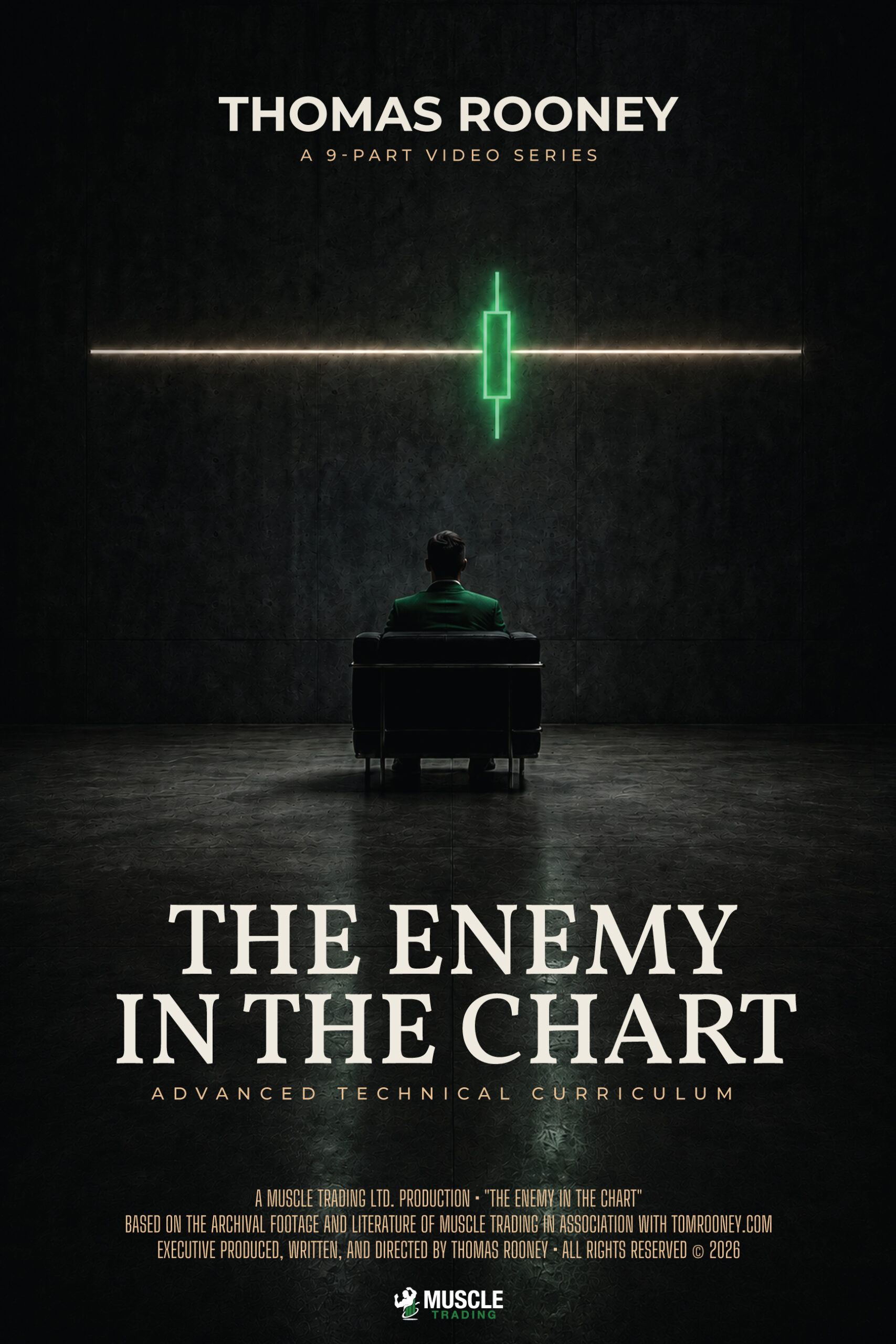
Although mentorship and the live members community officially concluded in 2021, Thomas Rooney continues to archive his structural research, market essays, and analytical insights, which remain accessible inside the library section of this site. This repository includes open-source learning materials engineered to strengthen core skills in risk management, investing, and macro financial literacy. As part of this ongoing dedication to media and legacy preservation, our dedicated productions page fully supports his flagship 5-hour video series, The Enemy in the Chart: Advanced Technical Curriculum, which is distributed globally via Spotify and Apple Podcasts on October 9, 2026, alongside his published literature and multi-platform streaming assets. https://theenemyinthechart.com

Educational Resources:

Explore my X.com (formerly Twitter) and StockTwits archives, where I shared real-time market analysis, watchlists, and trading insights from 2016 – 2020. This collection offers a transparent look into my trading strategies, stock picks, and thought processes during that period. It remains a valuable resource for those looking to study real-world chart setups, trading psychology, and strategy evolution.

Lessons from Teaching & Trading:

Honoring What Was, Embracing What's Next

Always remember, that the markets reward those who think. By staying in control of your emotions, you stay in control of your money. Patience, discipline, and thoughtful decisions are your greatest assets – rush neither into fear nor greed, and let careful strategy guide your path to success.

Thank you for taking the time to stop by. Wishing you continued growth, fulfillment, and success in all your endeavors.

Please note: Any available content is for educational purposes only and does not constitute financial advice. Past performance is not indicative of future results.

1 on 1 Mentorship Highlights

What Skills You'll Gain

Comprehensive Understanding of Trading
Grasp the fundamentals of trading and how to execute trades more profitably.
Enhanced Psychological Fortitude
Learn to finetune your emotions for better trading profits.

Improved Technical Grasp

Utilize technical analysis for explosive trading capabilities.

Competitive Edge​

Obtain charting and screening software and discover stock-search settings.

Please note: Any available content is for educational purposes only and does not represent financial advice. Past performance is not indicative of future results.

Watch Tom Motivate

Video Testimonials

Muscle Trading App

Looking for Our App?

Our live members chat has been retired. Everything is right here on our site.

Mentorship Academy Live Training

What You'll Specifically Learn

Mandatory Fundamentals

No recurring membership or other hidden fees!

    • An Introduction to Trading & The Markets
    • Receive All My Charting and Screener Software
    • Important Terms & Indicators
    • Brokerage Accounts
    • Profitable Ways to Place Orders
    • Candlesticks & Best Set-Ups
    • How to Use Resistance & Support to Profit
    • The Stop-Loss
Advanced Indicators & Strategies
  • Risk Management
  • Position Sizing
  • Habits to Avoid While in the Market
  • Importance of Share-Float Size
  • Stop-loss Strategies (Day/Swing)
  • Entry/Exit Strategies to Avoid Big Losses
  • Timing the “Top” & “Bottom” with Bollinger Bands
  • My Strategy for Buying “Off the “Bottom”
Swing and Day-Trade Mastery
  • How to Enter a Trade on the “Breakout”
  • How to Follow an Uptrend for Swing Trading
  • Plotting Support & Resistance Levels
  • Incorporating Moving Averages for More Profit
  • MACD for Maximum Swing Trade Profits
  • How to Use VWAP for Day-Trading
  • Optimal Entry & Exit Strategies for Day Trading
  • Best Charting Timeframes for Day-Trading
Tools and Research
  • My Stock Screener and Settings
  • Top Scanner Criteria for Day & Swing Trading
  • Understanding Earnings & Market Methodology
  • How to Trade Industries and Sectors
  • Find the Most Profitable Swing Trade Setups
  • How to “Trade the News” Accurately
  • Recognizing Overbought & Oversold Stocks

Video on Demand

Gain immediate access to Muscle Trading’s compete library of stock trading literature and have a wealth of knowledge at your fingertips. Take your trading to the next level and start your journey of stock trading education today.

Charting Instruction

Detailed, simplified, and easy to understand charting strategies

Search Criteria

Find the next breakout stock with screener settings that are easy to configure and understand

Educational Content

Straight-forward education that removes the “complication”

Market Fundamentals

Decipher market trends and understand how sectors correlate to price moves

Muscle Trading Video Course

Beginners Corner

Penny stocks are shares of small companies that trade at a very low price, usually under $5 per share in the U.S.

Key points:

  • They are often high-risk because the companies are small, less established, and their stock prices can be very volatile.

  • Penny stocks can offer big potential gains, but losses can be just as fast.

  • They are often traded over-the-counter (OTC) rather than on major exchanges, which can make them harder to buy and sell.

Simple takeaway:
Penny stocks are cheap, risky shares of small companies — they can be exciting, but you need to be careful and do your research.

pump and dump is a type of stock scam that often targets penny stocks.

How it works:

  1. Scammers “pump” up the stock price by spreading hype, false news, or misleading claims to get people excited and buying.

  2. Once the price rises, the scammers “dump” their shares at a profit, causing the stock price to crash.

  3. Investors who bought in late usually lose most or all of their money.

Simple takeaway:
A pump and dump is a fraudulent scheme that inflates a stock’s price so scammers can sell at a profit — it’s especially common with low-priced, thinly traded penny stocks.

security is a financial instrument that represents ownership (equity), debt (loan), or the right to future profits. Securities are bought and sold in financial markets.

Common types of securities:

  • Stocks: Represent ownership in a company.

  • Bonds: Represent a loan you give to a company or government.

  • Derivatives: Contracts whose value depends on an underlying asset.

Simple takeaway:
A security is basically something you can invest in or trade to potentially earn money or returns.

commodity is a basic physical good that can be bought, sold, or traded, usually in large quantities. Commodities are often natural resources or agricultural products that are interchangeable with others of the same type.

Common examples:

  • Energy: Oil, natural gas

  • Metals: Gold, silver, copper

  • Agriculture: Wheat, coffee, corn

Key point: Commodities are standardized, meaning one unit is essentially the same as another, which makes them easy to trade o

A derivative is a financial contract whose value is based on the price of something else — called the “underlying asset.”

  • The underlying asset could be a stock, bond, commodity, currency, or even an index.

  • Derivatives allow investors to bet on the future price of that asset without actually owning it.

  • They are often used for hedging risk or speculating on price movements.

Common types of derivatives:

  • Options: The right (but not the obligation) to buy or sell an asset at a set price by a certain date.

  • Futures: An obligation to buy or sell an asset at a set price on a future date.

  • Swaps: Agreements to exchange cash flows, like interest rates or currencies.

Simple takeaway:

  • Think of derivatives as financial contracts tied to something else. They can protect you from risk or let you try to profit from price changes without owning the asset itself.

Firstly, you must be in the best stocks that have the highest chance at making a profitable run. These stocks can be priced in any range of my choosing and are found by analyzing certain technical indicators and as well by using stock screeners and scanners. I have developed personal search criteria that I plug-in to these screeners to better investigate the market each day. Once I find those stocks I will plot them on my charts and analyze my technical indicators to narrow down my search even further. By doing this it is my goal to find two or three stocks out of all of the thousands in the market that show the highest probability of an upward move in the short term.

1. Stocks

  • stock represents ownership in a single company.

  • When you buy a stock, you own a small piece of that company and can benefit from price increases and dividends.

  • Example: Buying shares of Apple means you directly own a portion of Apple.

2. ETFs (Exchange-Traded Funds)

  • An ETF is a collection of many stocks (or other assets) bundled together.

  • ETFs trade on stock exchanges like individual stocks, so you can buy and sell them throughout the day.

  • They offer instant diversification because you’re investing in a basket of companies, not just one.

  • Example: An S&P 500 ETF gives you exposure to the 500 largest U.S. companies in a single purchase.

3. Mutual Funds

  • mutual fund is also a collection of stocks, bonds, or other assets, but it’s usually actively managed by a fund manager.

  • Mutual funds don’t trade on stock exchanges throughout the day; you buy or sell shares at the fund’s end-of-day net asset value (NAV).

  • They often have higher fees than ETFs due to management costs.

  • Example: A growth-focused mutual fund may invest in tech and healthcare companies and is actively adjusted by the manager.

Which one is best to buy?

There’s no one-size-fits-all answer — it depends on your goals, risk tolerance, and how much time you want to spend managing your investments.

  • Stocks: Good if you want to focus on individual companies and don’t mind more risk and research. Can offer higher potential rewards but also bigger losses.

  • ETFs: Great for beginners or anyone wanting instant diversification. Usually lower fees than mutual funds and easier to trade like a stock.

  • Mutual Funds: Often better if you want professional management and are investing for the long term, but they can have higher fees and less trading flexibility.

Simple takeaway:

  • For hands-on trading or picking favorites → stocks

  • For easy, diversified investing → ETFs

  • For long-term, managed investing → mutual funds

✅ Key tip: Many investors combine them — for example, holding a few individual stocks while putting the rest in ETFs for broad diversification.

Yes. To buy or sell stocks, ETFs, or other securities, you need a broker—a company or platform that executes trades for you. Many people use brokerage accounts offered by their bank, which can be convenient if you already have a checking or savings account.

How do I choose one?
When picking a broker, consider:

  • Fees and commissions: Look for low costs, especially if you’re starting small.

  • Ease of use: A beginner-friendly platform with intuitive tools helps you learn faster.

  • Account types and offerings: Make sure they offer the securities you want to trade (stocks, ETFs, etc.).

  • Educational resources: Some brokers provide tutorials, webinars, and articles that can help you grow.

  • Customer support and reputation: Check reviews and ensure the broker is regulated by a reputable authority.

Simple takeaway:
You need a broker to trade, and your bank might already offer one. When choosing, focus on low fees, ease of use, and helpful resources—especially if you’re just starting out.

stop loss is an order you place with your broker to automatically sell a stock or other investment if its price falls to a certain level. It’s a way to limit losses and protect your investment.

How do I use it?

  • Decide the maximum loss you’re willing to accept on a trade.

  • Set your stop loss at that price with your broker.

  • If the stock price falls to that level, your broker automatically sells it, preventing further losses.

Simple example:
If you buy a stock at $50 and set a stop loss at $45, your stock will automatically sell if the price drops to $45, limiting your loss to $5 per share.

Key takeaway:
Stop losses help you manage risk and avoid emotional decisions by automatically selling if the trade goes against you.

Technical Analysis vs. Fundamental Analysis

1. Technical Analysis (TA):

  • Focuses on price movements and patterns in charts.

  • Traders use it to predict future price changes based on historical data, trends, and indicators.

  • Example tools: moving averages, trendlines, volume analysis.

  • Think of it as studying the market’s behavior to decide when to buy or sell.

2. Fundamental Analysis (FA):

  • Focuses on a company’s financial health and long-term value.

  • Investors look at revenue, earnings, debt, industry position, and management quality.

  • Example tools: financial statements, earnings reports, P/E ratios.

  • Think of it as studying the company itself to decide if it’s worth investing in.

Simple takeaway:

  • Technical analysis: “When should I trade?” (timing based on charts)

  • Fundamental analysis: “Is this company worth owning?” (long-term value based on fundamentals)

trading plan is a written guide that outlines how, when, and why you will trade. It helps you stay disciplined and avoid emotional decisions.

Steps to create one:

  1. Define your goals: Are you trading for extra income, long-term growth, or learning?

  2. Decide what to trade: Stocks, ETFs, options, or other assets.

  3. Set entry and exit rules: Determine when you’ll buy, sell, or use tools like stop losses.

  4. Manage risk: Decide how much of your capital to risk per trade and set stop-loss limits.

  5. Track and review: Keep a journal of your trades, review what works, and adjust your plan over time.

Simple takeaway:
A trading plan is your roadmap — it defines your strategy, risk limits, and goals so you can trade confidently and consistently.

Coming October 9, 2026

A 5-Hour, 9-Episode Video Series Compiled from the Muscle Trading Archives

The Enemy in the Chart

Frequently Asked Questions

Absolutely! No prior experience with Trading is required. We start with the basics and build up to more advanced concepts and strategies.

Our two stock trading courses total nearly 5 hours of educational literature, while our crypto series is 1.5 hours of learning material.

No there aren’t any certificates provided.

This website is now a legacy archive. While support for purchased products is no longer available, feel free to explore our free resources – including our blog posts, and real-time trade commentary from 2016-2020 on X.com and StockTwits. Thank you for your understanding and support. 

You will have access to the course material for one year.

That all depends on your risk tolerance. There is no set amount, but rather whatever you feel comfortable trading with – for example: a $2000 account. (Not financial advice).

It is always recommended for a beginner to begin with paper-trading for several weeks or months until they feel comfortable entering the market with real money. A paper-trading account is essentially a trading practice-account which uses “virtual funds” that aren’t real. This allows perspective traders to sharpen their skills and gain confidence in their trading abilities.

We are unable to offer refunds on our digital courses or personal mentorship program.


Tom Rooney, founder, author, and former headline performer, in grey suit sitting with hands clasped - black backgroundThomas Rooney is the founder of Muscle Trading Ltd. and a dedicated advocate for financial literacy and independent thinking. With years of experience mentoring traders, he combines technical expertise with a deep understanding of mindset and performance. Before building his trading education platform, Tom spent a decade as a professional stage headliner — a journey that sharpened his discipline, presence, and resilience under pressure. His lifelong commitment to physical fitness and healthy living reflects the same principles he teaches in the markets: perseverance, consistency, and mental fortitude. 

Contact

support@muscletrading.com

Please check your email, including junk and spam folders after submitting this form.

Professional Portrait of Tom Rooney - Founder and CEO of Muscle Trading Ltd.